 Guide
Guide
How to Automate Call Center QA with a Transcription API
Most call centers sample between 1% and 5% of their calls for quality review. That means 95% or more of customer interactions are never evaluated. Managers have no idea how agents perform on the calls nobody listens to. Compliance violations, missed upsells, and customer frustration go undetected for weeks.
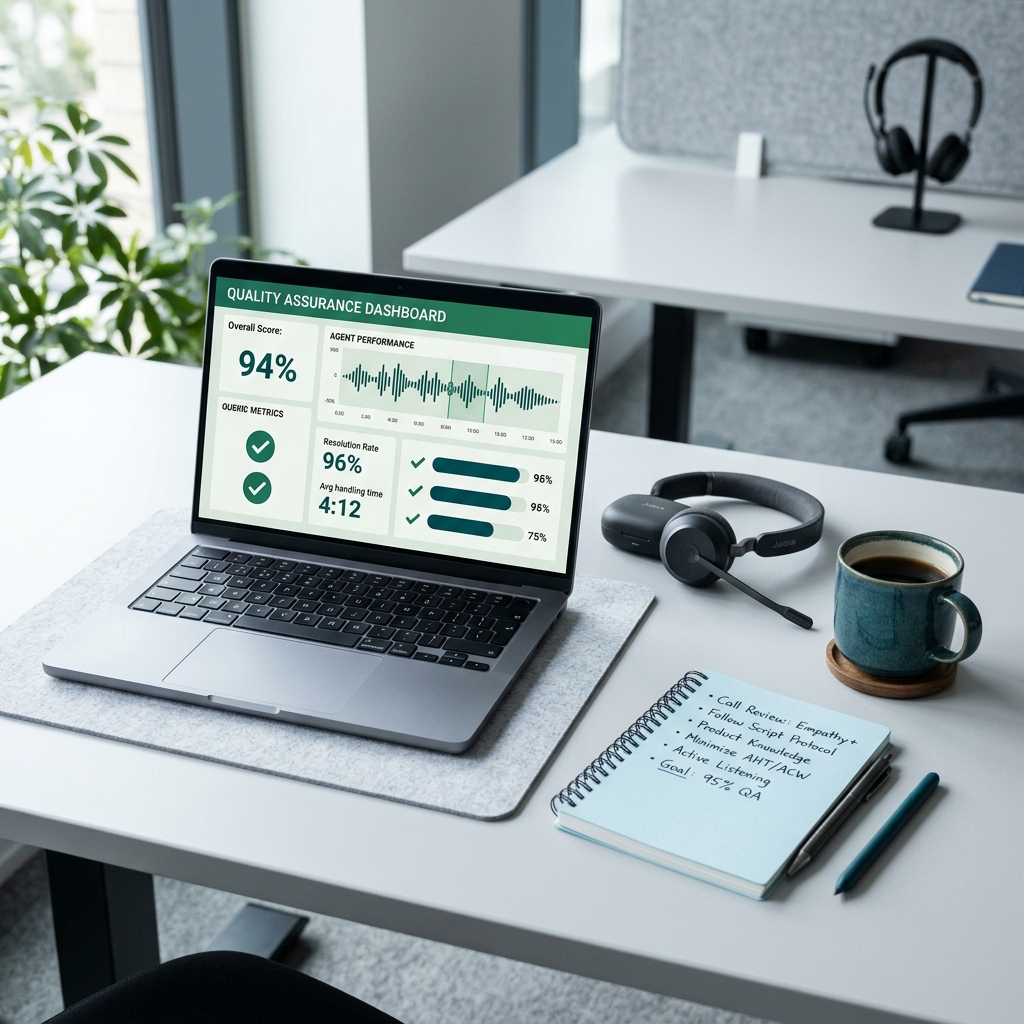
Automated QA changes that math entirely. With a transcription API that includes speaker diarization and sentiment analysis, you can score every single call against a consistent rubric, in real time, without hiring additional QA analysts.
Why manual QA is broken
Traditional call center QA relies on human reviewers listening to random samples, filling out scorecards, and delivering feedback in monthly coaching sessions. This model has three fundamental problems:
- Coverage gap: At 3% sampling, a center handling 10,000 calls/month reviews only 300. The other 9,700 are invisible.
- Consistency gap: Two reviewers scoring the same call often disagree by 15-20 points. Human judgment varies by mood, fatigue, and bias.
- Timing gap: Feedback delivered 4 weeks after a call is nearly useless. Agents cannot remember the context, and the coaching moment is gone.
Automated QA eliminates all three. Every call is scored against the same criteria, within seconds of completion, using objective data instead of subjective impressions.
What 100% automated QA looks like
- Audio ingestion: Call recordings are uploaded to a transcription API as they finish
- Structured transcription: The API returns a diarized transcript (agent vs. customer) plus AI analysis
- Scoring engine: Your application evaluates the structured response against your QA rubric
- Alerting: Calls below threshold trigger immediate supervisor notifications
- Dashboard: Aggregate scores surface trends for coaching prioritization
What your API needs to return
Not every transcription API gives you enough data to build automated QA. You need these four outputs in a single response:
- Speaker diarization: Which words belong to the agent and which to the customer
- Per-speaker sentiment: Detect when customer mood shifts and whether the agent improved or worsened it
- Call summary and type: Automatic classification for type-specific scoring rubrics
- Compliance flags: Detection of sensitive data (card numbers, SSNs) shared during the call
VoxParse returns all four in a single synchronous API call. No separate requests, no polling, no stitching results together.
Building the pipeline
Step 1: Upload and transcribe
curl -X POST https://api.voxparse.com/v1/transcribe \
  -H "X-API-Key: YOUR_API_KEY" \
  -F "[email protected]" \
  -F "custom_instructions=Score this call for QA. Identify greeting compliance, empathy signals, resolution effectiveness, and closing quality."
Step 2: Parse the structured response
{
  "ai_analysis": {
    "call_summary": "Customer called about incorrect charge...",
    "call_type": "billing_dispute",
    "call_outcome": "resolved",
    "sentiment": {
      "customer_sentiment": "frustrated_to_satisfied",
      "agent_sentiment": "professional"
    },
    "compliance": {
      "identity_verified": true,
      "sensitive_data_shared": ["credit card last 4"]
    }
  }
}
Step 3: Apply your scoring rubric
def score_call(analysis):
    score = 0
    transcript = analysis["transcript_cleaned"].lower()

    # Greeting (20 pts)
    if "thank you for calling" in transcript[:200]:
        score += 10
    if analysis["agent"].get("name"):
        score += 10

    # Empathy (20 pts)
    empathy = ["i understand", "i apologize", "let me help"]
    agent_text = " ".join(
        l for l in transcript.split("\n")
        if l.startswith("agent:")
    )
    score += min(sum(1 for p in empathy if p in agent_text) * 5, 20)

    # Resolution (30 pts)
    if analysis["call_outcome"] == "resolved":
        score += 30

    # Sentiment trajectory (20 pts)
    if "to_satisfied" in analysis["customer"].get("sentiment", ""):
        score += 20

    # Compliance (10 pts)
    if analysis["compliance"]["identity_verified"]:
        score += 10

    return {"score": score, "pct": round(score / 100 * 100)}
Step 4: Flag and alert
- 90-100%: Excellent. Queue for positive recognition.
- 70-89%: Acceptable. Log for trend analysis.
- 50-69%: Needs coaching. Alert direct supervisor.
- Below 50%: Critical. Immediate notification plus compliance review.
The 5 metrics that matter
| Metric | Weight | Data Source |
|---|---|---|
| Script adherence | 20% | Diarized transcript (agent lines) |
| Empathy and tone | 20% | Agent sentiment + phrase detection |
| Resolution | 30% | Call outcome + customer trajectory |
| Compliance | 15% | Identity verification + PCI handling |
| Efficiency | 15% | Duration vs. call type benchmark |
Cost: 100% QA vs. manual sampling
| Metric | Manual QA | Automated (VoxParse) |
|---|---|---|
| Calls reviewed | 300/mo (3%) | 10,000/mo (100%) |
| QA staff | 2 FTEs ($120K/yr) | 0 |
| API cost | $0 | ~$2,450/mo |
| Annual total | $120,000 | $29,400 |
| Savings | - | 75% less, 33x coverage |
What this unlocks
- Real-time coaching: Alerts during or right after calls, when context is fresh
- Trend detection: Spot systemic issues within days instead of months
- Agent benchmarking: Statistically significant comparisons, not sample-size bias
- CSAT prediction: Correlate QA scores with surveys to predict satisfaction
- Compliance proof: 100% PCI/HIPAA monitoring with timestamped evidence
For more on the compliance angle, see our guide on automatic PII redaction and financial data extraction.
Start with 5 free hours
That is enough to QA approximately 300 calls. All features included at $0.49/hr.
Get your API key →Bottom line
Manual QA sampling was the best we could do before AI transcription matured. In 2026, there is no reason to leave 97% of your calls unreviewed. The technology exists, the cost is lower than human reviewers, and the coverage is orders of magnitude better.
Start with the complete guide to call center transcription APIs if you are still evaluating providers, or check the API documentation to start building today.